Category Archives: Runco

Runco Broadens Award-Winning LightStyle Series with High Bright Projector

The new 3-chip DLP LS-10HBd provides homeowners exceptional entertainment value without compromising video quality or scale

Beaverton, OR – Runco International, the leading brand in luxury display solutions and part of the global leader in specialty display solutions Planar Systems, Inc., (NASDAQ: PLNR) is taking its award-winning LightStyle™ Series to new heights of brightness and scale with the new LS-10HBd.  Measuring more than 3,780 lumens before calibration, this high-bright 3-chip DLP® projector creates stunning video at a scale unattainable by other display types, in environments that may not be conducive to other projection technology, and offers customers an affordable big screen video experience in virtually any room of the house.

With its 3-chip, 1080p design and stunning brightness, the LS-10HBd opens up new projection possibilities in the home, especially in “Flex Theaters”—living rooms, media rooms, and entertainment spaces in the home where big screen entertainment is only a portion of the room’s purpose, and where even the highest performance front projection systems can struggle with environmental factors like ambient light and shadows. The incredible brightness, along with the ISF™ Day and Night modes of the LS-10HBd, make it possible for families to truly get the most from their DVDs and Blu-ray® discs, television programming, internet video, and computer-based media and spectacular sizes, without compromising the room’s design or décor. 

“When clients rave about the quality and the range of options available, it is clear why the LightStyle series is one of our best selling projection lines,” said Jennifer Davis, vice president of marketing for Runco. “The new LS-10HBd projector truly enhances the line by bringing it into bigger and brighter spaces than ever before, without compromising quality, value, or the sleek, stylish industrial design for which LightStyle is known.”

Runco’s LightStyle Series projectors are well-regarded for their craftsmanship and video quality, and in taking the line to new heights of brightness, the LS-10HBd still maintains the performance and integrity of its predecessors. It boasts flawless 1080p full high-definition presentation, full integration with the leading home automation systems, and a sophisticated industrial design that complements any space. 

Runco’s LightStyle Series combines state-of-the-art DLP-based SuperOnyx™ technology with the ISF (Imaging Science Foundation) calibration suite for optimal performance, further enhancing the flexibility of installation and use. The LS-10HBd also ships with Runco’s award-winning Digital High-Definition 4 (DHD 4) external video processor for the utmost in processing, scaling, and control. Designed to be rack mounted, the external DHD 4 offers advanced connectivity options, as well as installation flexibility, because it can be located next to, and connect directly to, all other source components with a single-wire connection from the controller to the projector, making it an ideal solution for retrofit installations.

As with all other LightStyle projectors, the LS-10HBd is available with Runco’s optional  CineGlide™ lens solution, which enables viewers to switch from 16:9 content to 2.35:1 ultra-widescreen films without black bars on the top or sides of the image at the touch of a button. 

Its sleek design can be customized with Runco’s FinishPalette™ design options, which offer full-color design options, ranging from matte white to camouflage ceiling installations to a gallery of artist impressions, a line of Signature colors, or even custom client-supplied artwork.

For more information about Runco or to find a local dealer in your area, please visit www.Runco.com.

Runco LightStyle LS-1 Home Theater Projector

There are luxury brands that we all know—Mercedes, Louis Vuitton—and there are luxury brands that are known primarily among aficionado groups—Cohiba cigars, Sage fly fishing rods. Runco tends to be a brand that falls more in the second category. It has a reputation for offering spectacular, and spectacularly expensive, home theater projectors. For instance, at a CEDIA Expo press conference in 2011, the company spent most of the 40 minutes demonstrating a jaw-dropping projector that clocks in at over $200,000. That’s without the screen or the popcorn.

Why do I point this out—because alongside such extravagances, the company now offers a product that will get the Runco name, along with a lot of the Runco prowess, into homes for a lot less.  Last year the company introduced the LightStyle line of projectors which tend to be less expensive than Runco’s other systems (though the three-chip models do get up there). They also don’t don’t look like industrial air conditioners. The LS-1 reviewed here carries an MSRP of $3,999.

Actually, being round and squat, they look a little like Roombas. That’s not a bad thing. These are stylish little projectors (you can also customize them with a color palette or team logo) that won’t look at all bad snugged up against your ceiling.

The LS-1 is a single-chip DLP projector. The company specs rate it as having a 10,000:1 contrast ratio and 780 ANSI lumens brightness. That seems a bit low since other companies offer cheaper models with more than 1,000 lumens, but you’ll see from my testing, that performance wasn’t hindered by that number.

Setting up the Runco, I found that while it’s an entry-level product, it certainly didn’t feel like it when I lifted all 18 pounds of it out of the box. With that kind of heft, either the company packed in some extra sand bags, or it’s got a lot of heavy-duty features making it work.

The second thing I noticed was that the inputs all seemed to be missing. Actually they’re nicely covered by a removable panel. This is one of those features that make the projector look more like something you’d want in your family hang-out room and less like something hanging from the ceiling in a classroom.  Accessing the input panel I found two HDMI ports, 1 component, 1 RGB, s-video and composite plus an RS-232 for control systems.

On top there’s a small control panel for access the menu and such, but you’re much better off depending on the remote for all those operations.

Speaking of the remote—it’s backlit so you can use it in the dark, and it’s logically organized and easy to use.

Runco has being catering to the video enthusiast long enough to know what people expect, so it wasn’t a surprise to find features like ISF day/night settings for calibration, built-in test patterns and Runco’s ViVix processing. All of that shows the projector was designed to be tweaked for a good picture.

Of course, in this case, the projector didn’t need to be tweaked very much. I aimed it at a 106-inch Seymour Screen Excellence screen with a .98 gain. Runco includes a manual vertical lens shift to help you hit the bulls eye—in this case you access the lens shift by lifting up the Runco logo and turning a mechanism with an included allen wrench.  After that, a little adjusting in the picture menu and I was off to watch some video.

First, the projector did an excellent job on test patterns, so I played a few Blu-ray movies. I started with the snow board documentary The Art of Flight. This disc is a beauty, so get it if you don’t already have it. The wide shots of snow-covered peaks against blue skies looked stunning. The picture capture all the depth and variation in the different shades of white to gray you find in snow and ice coupled with the shadows of the mountains.

In one scene a helicopter hovers over the mountain, its blade rotating in slow motion. I expected the spinning of the chopper blades to create artifacts, but there were no jagged edges or mosquito noise anywhere to be seen. In another scene where a brightly-clad snow boarder launches across the screen, his board at a diagonal and nothing but a blue sky behind him, every edge was perfect.

I moved onto footage with more dark scenes, including Avatar and Harry Potter and the Deathly Hallows II. In both movies, the projector created very rich colors with fine detail, and dark scenes also looked good. Blacks were deep and showed detail in shadows, though I’ve seen somewhat better on LCoS projectors in the same price range.

As noted above, this projector is not excessively bright—it’s best great in a dark to moderately dark room. If you want to watch a football game during the day with the lights on, don’t expect the deepest contrast.

Some people shy away from single-chip DLP because of the rainbow effect—an artifact caused by the projector’s color wheel. I’m not terribly sensitive to that anomaly, but I can see it and know how to look for it. On this Runco I did not experience it even once. I tried, but nothing. This is only single-chip projector I’ve seen that, at least for me, exhibited no rainbow effect at all.

Altogether, this is a great, reasonably-priced projector that gives a significant improvement over the bargain projectors in the $1,000-$3,000 range. If I had to nitpick, I’d have to say the lack of 3D might be a turn-off, considering the fact that there are several 3D projectors for about the same price (JVC’s DLA-X30 comes to mind). This unit also seemed a little loud, but most of the time I used it without any accompanying audio (and I was sitting right next to it). In a normal ceiling installation the projector will be farther from the viewers and have a soundtrack to cover any fan noise.

Runco LightStyle LS-5

Runco LightStyle LS-5

The Runco LightStyle LS-5 costs a packet, but its performance with HD is glorious

  • For

    Excellent detail resolution, contrast; comprehensive menus; good connectivity; sensible remote handset

  • Against

    On paper and physically cheaper rivals seem to offer as much or more

By Runco‘s usual standards, the LightStyle LS-5 is something of a budget product.

The LS-5’s lowly status (in Runco’s range) is reflected in the relative lack of luxury features and fairly basic spec. It’s a Full HD single chip DLP projector with a six-segment colour wheel.

We usually see motorised focus at this kind of price level and some kind of easy way to lens shift. That’s not the case here: the LS5 has to be focussed and zoomed manually, and lens shift requires the rather odd arrangement of removing a small plastic cover and adjusting horizontal and vertical shift with the use of a supplied Allen key.

It all seems oddly basic for a product of this price, and much cheaper rival projectors from the likes of Panasonic have far more elegant manual arrangements.

Take a look at the menus, though, and the difference between this and cheaper offerings starts to become clear. There’s a wealth of adjustability here, from control over three types of noise reduction algorithms (general, block noise and mosquito) to myriad options for sharpness, gamma, and overscan.

Want to play around with colour? You’ll be in heaven with the vast range of fine-tuning available here. We ended up with noise reduction and sharpness on low settings, with all the other settings, ‘off’ or ‘standard’.

An impressively rendered picture
With a film as gloriously animated as the surprisingly creepy Coraline, the Runco delivers an impressively rendered picture.

Animated films on Blu-ray tend to look good on most digital displays, but even so, this projector wowed us with its clarity. There’s very little picture noise in the dark scenes, and the projector handles fast motion as securely as we’ve seen from a DLP.

We’re particularly impressed by its ability to combine bright whites in a dark scene without overly compromising either. All manufacturers claim a high contrast figure – it’s 15,000:1 for the LS-5 – but few can back it up so convincingly.

Moving onto some more natural source material, we try the Blu-ray of Clint Eastwood’s Gran Torino and continue to be impressed.

The LS-5 has a wonderfully subtle way with colours, combining richness with naturalness in a way rarely seen. Edges are defined with pleasing stability, which helps the projector when it comes to revealing fine detail – like, say, the individual blades of grass on Walt Kowalski’s lawn or the subtle shadows on his (always immaculately clean) Ford Gran Torino.

Fine scaling with SD
A switch to standard definition – both DVD and off-air transmissions – reveals the Runco to have a fine scaler and deinterlacer. While the LS-5 doesn’t hide the limitations of standard-definition signals, it still delivers a clean and detailed picture for the standard.

There’s no denying that $6995 is a hefty chunk of money to spend on a projector, particularly when excellent products such as JVC DLA-HD550 are available for around half as much.

Yet, view a carefully calibrated LS-5 with a suitable high quality source and there’s no denying its picture is truly amazing.

If picture performance is paramount, and you have the budget, we have no doubt this Runco is worth the money.

Introduction to the Runco LightStyle LS-100d Projector

For a truly immersive home theater experience, nothing compares to a large image that fills your field of view.  Unfortunately many of us don’t have a room that will work for a projector due to space and throw limitations and are forced to make do with a far smaller plasma or LCD display.  Runco has a solution for those challenging situations with their LS-100d, a short throw, LED-based projector capable of producing a 100″ image while being placed right up against the wall.
runco_projector_side_small

Design and Setup of the Runco LightStyle LS-100d Projector

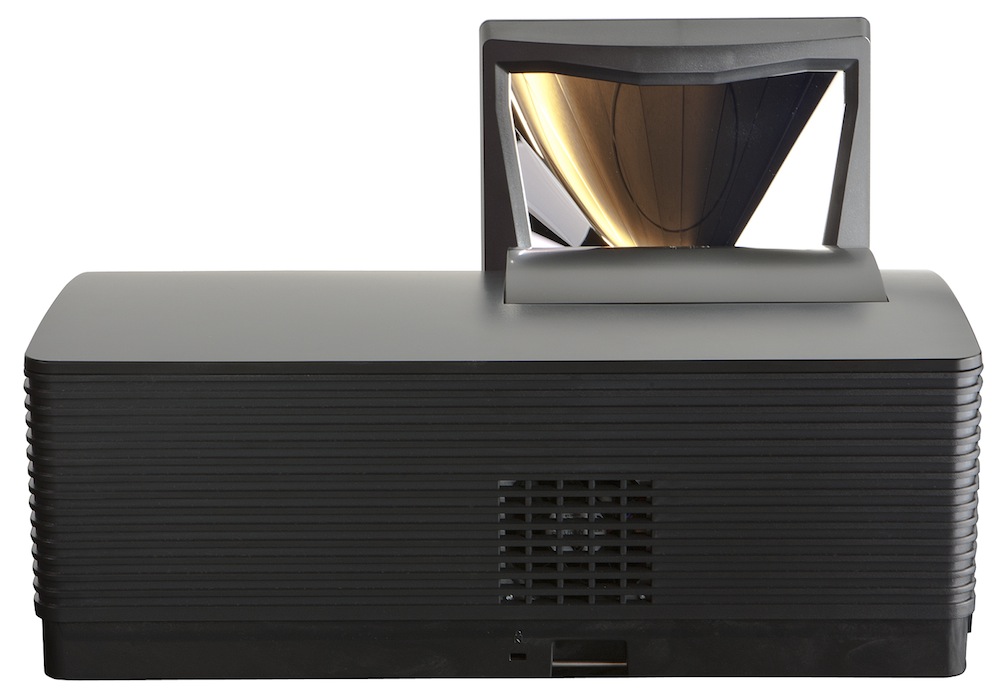
The LS-100d manages to pull off this feat with a specially designed curved mirror that takes the image off the lens and projects it onto the screen.  This design means that the LS-100d lacks any lens zoom or shift controls, as those would not be able to interact with the mirror assembly.  With this setup the LS-100d can provide an image between 84″ and 100″ in size, depending on how close you are able to place it to your screen.  Focus controls are available, but the design of the LS-100d makes all other lens controls unnecessary.

runco_projector_back_small

Providing the image is a DLP chip powered by an LED light engine.  The use of an LED engine means you won’t ever have to worry about replacing a bulb over the life of the projector, and the light output should not have a noticeable decrease over time.  It also prevents the dreaded rainbow effect that some people suffer from with DLP-based projectors.  With the recommended 1.0 gain screen, the projector is capable of close to 13 ftL of light off an 84″ screen after calibration, and close to twice that with maximum output.

runco-ls-100d-small-1

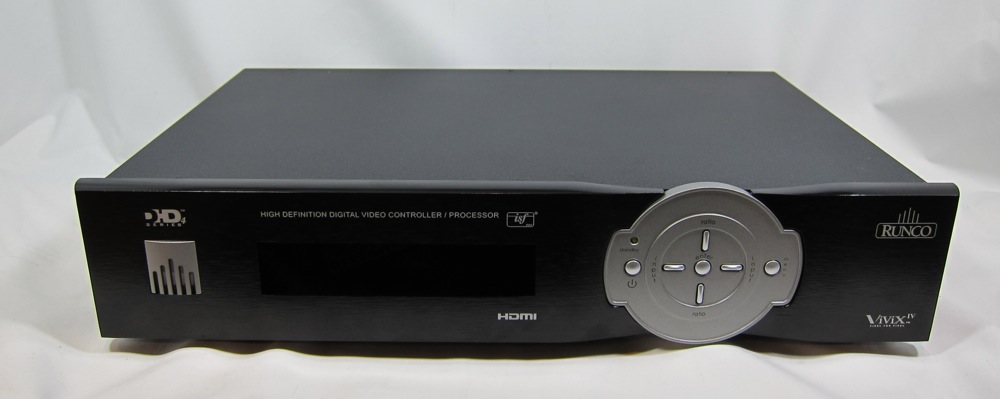
The d at the end of the LS-100d model designation indicates that the image processing controls for the LS-100d is contained in the external DHD4 controller.  The DHD4 has all of the inputs one could require with 4 HDMI, a Component, 3 Composite and 2 YPbPrHV inputs that allow for RGB or Component video.  The DHD4 also has dual HDMI outputs, allowing you to run one to the projector and one to your surround sound processor, allowing the DHD4 to handle all the video and processing.

runco-ls-100d-small-3

The DHD4 provides for full video processing, including video scaling and full ISFccc controls for custom installers.  These controls are locked out from users, but allow for ISF Day and Night modes to be setup, and these are unique to every input, allowing the LS-100d to be truly calibrated for every source component to get the best performance.  The initial settings out of the box were very far off the HDTV standards, but once the Rec 709 color gamut is selected in the calibration controls, the settings were nearly spot on without any additional adjustments.  For those that want even better controls, there are full HSL controls available for all six primary and secondary colors, as well as white balance and gamma settings.  Keeping the controls separate from the projector itself makes setup much easier, as you only need to run a pair of cables from the DHD4 to the LS-100d, making a custom install easier.

On that note, the Runco will be sold by a custom installer which will save you a lot of aggravation as the radical mirror assembly means that installation and placement is very hard to get right.  Setting it up with my screen meant getting the height and distance from the screen just right to get a 96″ 16:9 image, and then making sure it was not off-axis at all.  Any small alignment issues were very noticeable as it caused a radical shift in geometry.  As such this is a projector you will certainly want to be permanently installed with a screen and not attempt to move from room to room.


The Runco LightStyle LS-100d Projector In Use

Once positioned correctly I fired up the LS-100d and started by watching a bit of Cars 2.  As I hadn’t adjusted the CMS yet, I was amazed to see the colors that were jumping off the screen at me.  LEDs can produce a much wider color gamut than traditional bulbs, and so there were shades of red, green, and blue that I hadn’t seen on a home projector before.  It was very inaccurate, but it was also eye-popping to see that a projector could produce these colors, and really with CGI content the extra pop was nice.  After admiring the colors for a bit, I set the CMS to Rec 709 and Cars 2 looked normal again.

With the opening scene on the oilrig, blacks were a bit darker than I was used to with a DLP projector.  I’m not sure if the LEDs allow for this, or if it is that Runco uses a much higher quality glass lens instead of plastic that has less light bleed, but the letterboxing bars blended into the edge of the screen much better than usual.  Geometry issues from the mirror setup were not noticeable in regular viewing, nor were any other side effects of the mirror setup.

As you would expect with a DLP, the image was razor sharp.  CGI can be good for evaluating the sharpness, as there is no possible issue with the focus or a bad film transfer to introduce a soft image.  Cars 2 looked great, with all the details coming across.  DLPs are also fantastic with motion resolution and here it looked superb as well.  There was no smearing or blurring of the image, as the cars flew around the track in Japan and Italy, and with the LEDs also no rainbows visible.

With The Fifth Element, skin tones from Bruce Willis and Milla Jovovich were spot on without excessive reddish or sunburnt tones, but the rest of the color palette certainly popped off the screen.  The last DLP I had around was an earlier Samsung RPTV model and not an LED based projector, but I never had colors that were as accurate yet vivid as these.  On Drive, the shadow detail was rendered well, which is very important in a film as dark as this, though the nighttime aerial shots of Los Angeles lacked some of the pop that projectors with higher native contrast, instead of using an iris, can manage.  All 24p content was shown at 48 Hz, and despite my worries about the lower rate I had no issues with the image showing flicker or any other artifacts.

Watching Casino Royale, the opening scene had good, rich shadow detail and blacks that blended into the letterbox bars and edges of the screen.  Once the location moves to the Bahamas, the LS-100d can put out stunning, rich blue water tones that I think most displays would be hard pressed to match.  Even though when calibrated an LED display should look the same as a conventional display, the shade of water from the LED seemed to be a bit different.  Letterboxing bars were not visible at all, and tones that were supposed to look neutral and natural did, while the bright water and other items in the Bahamas had a ton of pop to them.

After a week, I got quite used to the LS-100d being at the front of the room, where I didn’t walk in the light path every time I stood up or moved around.  For a smaller room where it would be used, this makes it easier for your guests to move around while watching something without disturbing the image for everyone else.  It also makes it a far better solution for those who would play motion-based video games, like the Wii of Xbox Kinect, as you don’t constantly interfere with the projector.  That LED lights are able to power up and run in seconds instead of minutes, and that you don’t shorten their life by turning the projector on for 30 minutes to watch a TV show makes the LS-100d better suited to a living room than most projectors would be.

With the ability to turn the LS-100d on and off and not worry about shortening the life of the bulb, I was able to treat it more like a TV.  I’d turn it on to watch an episode of a TV show, or for 30 minutes of a movie, instead of having to ensure I had a long block of time so as not to waste my bulb hours.  This ability lets the LS-100d operate more like a TV in a living room or other common setting instead of only as a projector for when you have a lot of time to sit down and watch a full movie.  The LS-100d can easily work as a typical projector, but its design and setup allows it to also work as something more.

Conclusions About the Runco LightStyle LS-100d Projector

I’m sure some people are still thinking “$19,000 for a projector that only does a 100″ image?” but that isn’t the reason for the LS-100d to exist.  Some of us can’t fit a typical projector into our rooms.  Even if we could afford an 85″ or 103″ flat panel display it might not physically be able to get into a room or be supported by the wall.  The LS-100d lets you install a true home theater sized screen almost anywhere you want and be able to fill it as long as you have the wall space.

If you have the space for a traditional projector and don’t need the optical tricks that Runco uses with the LS-100d, they have plenty of other projectors you can look into.  If you always wanted to have that movie theater in your home, but never had the space to make it work, the LS-100d might be able to solve that for you, and put out an image that looks fantastic.  The Runco LS-100d is a wonderful product that fills a niche of the home theater market very successfully.